The three models, briefly
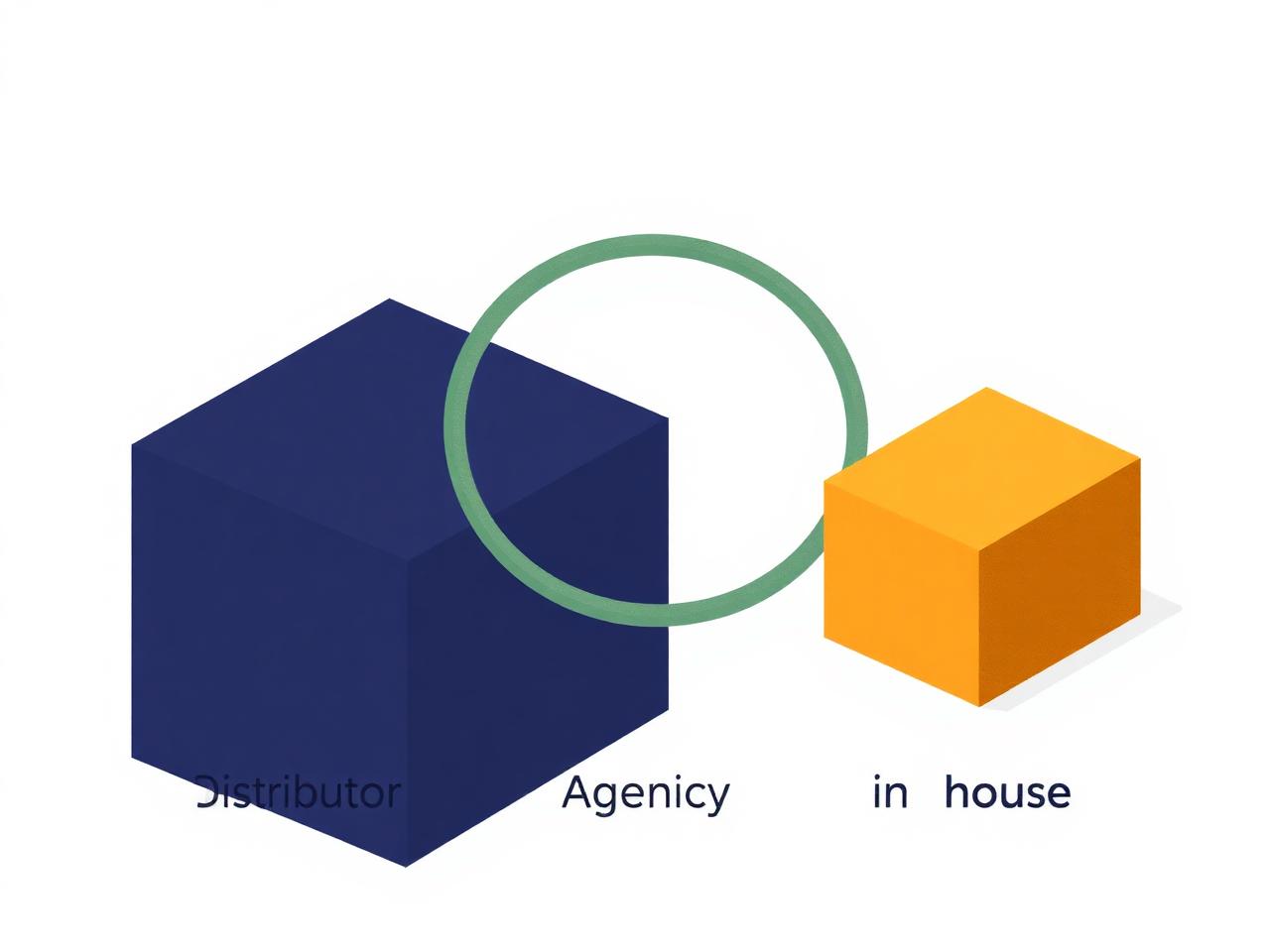
A traditional distributor buys your product wholesale and sells it on Amazon under their own seller account. They own the listing, the ads, the customer service, and the Buy Box. You get a PO and a check.
An agency runs your Seller Central account on your behalf. You own the account, the brand, the data, and the inventory. They handle the work and you handle the invoice.
In-house means you hire your own people and build the function internally. Could be one person juggling everything. Could be a team of five.
That is the shape of it. The real question is which one breaks in ways you can live with.
Where the traditional distributor model breaks
The traditional distributor model is the easiest to sell internally. No new hires, no agency retainer, no Seller Central learning curve. Cash hits the bank when the PO ships.
Here is what most brands miss. A commodity distributor is in the volume business, not the channel business. They want to move units. They are not staffing a team to fight unauthorized sellers off your ASINs, manage Transparency enrollment, refresh A+ content, or police MAP across resellers downstream. That is not what you bought.
For healthcare and beauty specifically this gets ugly fast. Compliance language matters. A distributor moving cases without your regulatory team's eyes on the listing is how brands end up with structure-function claims that cross the line, or a "treats" word sitting in a title that triggers an FDA letter. You find out about it when the listing goes dark.
“A commodity distributor is in the volume business, not the channel business. That is not what you bought.”
The downstream pricing problem is the other one. The minute you have one volume distributor, you usually end up with three or four resellers feeding off their inventory. Now you have a Buy Box war, MAP violations no one is enforcing, and price erosion that bleeds back into your wholesale channel.
Where the agency model breaks
Agencies make sense when you want a team running the work without the headcount. You own Seller Central. They bring the operators.
The failure mode here is variance. Most Amazon agencies are generalists running playbooks built for consumer electronics or apparel. Healthcare and beauty are different. Restricted category approvals, supplement claims compliance, OTC labeling, GMP documentation, ingredient flagging, all of it requires someone who has actually fought those battles inside Seller Central. A generalist agency will get your account suspended and then ask you for the FDA registration paperwork they should have asked for in week one.

The second failure mode is enforcement authority. When an unauthorized seller takes your Buy Box, an agency can send cease-and-desist letters and open IP claims on your behalf. That is the ceiling of what they can do. They cannot pull the listing at the source, because they are not the seller. They can recommend, escalate, and document. The actual leverage to shut bad actors down sits with whoever holds the seller account, and that is not them.
The third is the invoice. The retainer grows whether sales grow or not. Pay-on-performance agencies exist but are rare, and most of them quietly cap their downside in the fine print.
Where the in-house model breaks
In-house is the model brand leaders think they want until they try it. The pitch is clean. One person, fully accountable, deeply integrated with the brand team, no agency markup.
What actually happens is you hire a strong generalist marketer who learns Amazon on your dime for eighteen months. They get good. Then they leave for a 30% raise at a brand that needs an experienced Amazon lead. You start over.
The deeper issue is that Amazon is not one job. It is at least five. PPC strategy and execution. Catalog and listing operations. Brand registry and IP enforcement. Case management with Seller Support. Compliance and regulatory work in restricted categories. One person cannot do all of that well at any meaningful revenue. Two can, sometimes. By the time you are at three or four people in-house, you are running an agency inside your company with worse economies of scale and a single point of failure when someone quits.
“Amazon is not one job. It is at least five. One person cannot do all of that well at any meaningful revenue.”
The model we built: Value Added Distribution
When we started BAE Distribution, we were not trying to be a fourth flavor of the same thing. We built a model that fixes the specific points where the other three break.
We buy product from you the way a distributor does. We own the inventory and the channel risk. Then we operate Amazon the way the best agencies would, on your brand, by your standards, with your compliance team in the loop. Listing optimization, A+ content, brand storefront design, advertising management, image and copy refresh, unauthorized seller removal, Transparency Program enrollment, MAP enforcement, inventory and forecasting. All of it, included.
The difference is structural, not cosmetic.
Read down that right column. Each row is a failure mode of the agency model that disappears when the seller of record is the same operator running your channel.
Because we own the inventory, we are not billing you a retainer that grows when your sales do not. We make money when your product sells. Our incentives and yours point the same direction by default, not by negotiation.
Because we are the seller of record, when an unauthorized seller pops up on your ASIN, we do not write a letter and wait. We pull the listing at the source. MAP enforcement stops being a recommendation deck and starts being an action.
Because we operate the channel ourselves, decisions do not sit in a Slack thread waiting for three sign-offs. We act.
And because we built this for healthcare and beauty brands specifically, your compliance language, your regulatory constraints, and your category quirks are not something we learn on the job. They are baked into how we operate from day one.
“Each row is a failure mode of the agency model that disappears when the seller of record is the same operator running your channel.”
How to actually pick
Three questions cut through most of the noise.
Who holds enforcement authority?
If unauthorized sellers, MAP erosion, and rogue ASINs are real problems for you, the model needs to put authority in the hands of whoever is doing the work. Recommendations from a partner who cannot act are not the same as a partner who can.
What is your category risk profile?
Healthcare brands selling supplements, OTC, medical devices, or anything regulated need operators who know how Amazon treats those categories. Generalists will learn on your account, and the lesson tends to be expensive.
What are you actually paying for?
A retainer that grows whether sales grow or not is one math problem. An in-house team that costs more than it returns until you cross $5M on Amazon is another. The model that pays for itself out of margin on units sold is a third. Pick the one whose math survives a slow quarter.
Whichever model you pick, the failure mode is predictable. Pick the one whose failure mode you can manage, or pick the model that was built to not have those failure modes in the first place. That is what we built BAE Distribution to be.
Want to see what your Amazon channel could look like under our model?
We run healthcare and beauty brands on Amazon as a 2P Wholesale Retail Partner. Inventory, ads, enforcement, compliance, all under one roof, no retainer.